

Barite Powder: 7 Powerful Benefits for Reliable Oilfield Drilling
Barite Powder is a high-density mineral used as a weighting agent in oil and gas drilling fluids. By increasing drilling mud density, it helps operators manage hydrostatic pressure and support well-control plans. Petropath Fluids India Ltd. supplies drilling-grade material for oilfield applications where consistent quality, controlled particle size, and dependable supply matter. Selecting the correct grade and following the drilling-fluid programme are essential for reliable results.
What Is Barite Powder?
Barite Powder is a finely ground form of barite, a naturally occurring mineral composed primarily of barium sulfate (BaSO₄). Its high specific gravity makes it useful for increasing the density of water-based and oil-based drilling muds. Unlike reactive chemical additives, barite functions mainly as a physical weighting material and is generally insoluble under normal drilling-fluid conditions.
As a well becomes deeper, formation pressures can increase and vary across geological layers. Drilling fluid must be designed to provide suitable hydrostatic pressure while maintaining other required properties. Barite Powder allows mud engineers to adjust density according to the approved well programme and measured conditions.
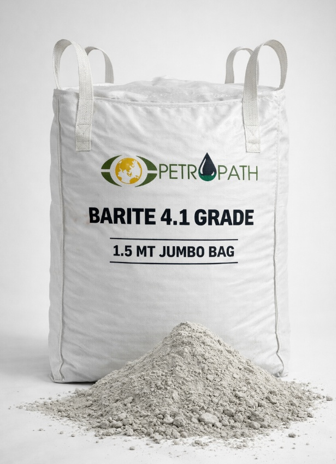
7 Key Benefits of Barite Powder
1. Helps Increase Drilling Mud Density
The primary purpose of Barite Powder is to raise drilling-fluid density to the target mud weight. This allows drilling teams to adjust the fluid system to the pressure conditions expected in the well. The quantity required depends on the starting mud density, desired density, and current fluid volume, so calculations should be completed by qualified mud personnel.
2. Supports Formation Pressure Management
Correct mud weight is an important part of maintaining a suitable pressure balance between the wellbore and surrounding formations. Barite Powder contributes to the hydrostatic pressure provided by the drilling fluid. It does not replace well-control procedures, pressure monitoring, or engineering decisions; it must be used within the approved drilling programme.
3. Useful in Water-Based and Oil-Based Mud
Drilling operations use different fluid systems depending on formation conditions, environmental requirements, and project objectives. Barite Powder is commonly used in both water-based mud (WBM) and oil-based mud (OBM) systems. Compatibility and final performance should be confirmed through routine testing of the complete formulation.
4. Supports Wellbore Stability
Maintaining appropriate fluid density can help manage formation pressure and support wellbore stability. Barite Powder is one component of a wider drilling-fluid system that may also need suitable rheology, filtration control, and solids management. The required density must be selected carefully because excessive mud weight can also create operational problems.
5. Provides Consistent Weighting When Properly Mixed
Uniform distribution of weighting material is important for maintaining consistent mud density throughout the circulating system. Add Barite Powder gradually through suitable mixing equipment, such as a jet hopper or high-shear mixer, while maintaining circulation. Check mud density at the appropriate points and avoid allowing the fluid system to become overloaded with solids.
6. Offers Practical Supply and Handling Options
Petropath lists industrial bags, jumbo bags, and bulk export packaging for project requirements. Packaging choice depends on consumption, storage facilities, transport access, and site handling equipment. Confirm the available packaging and delivery schedule before ordering, especially when coordinating material supply for large or remote drilling projects.
7. Supports Routine Drilling-Fluid Quality Control
Mud engineers monitor density alongside viscosity, gel strength, filtration, and solids content. Barite Powder helps achieve the target density, but the overall fluid must continue to meet the well programme’s requirements. Regular testing and clear records make it easier to identify changes and adjust the system under the direction of qualified personnel.
Technical Specifications
Petropath’s product page lists the following typical properties for its drilling-grade material:
Chemical composition: barium sulfate (BaSO₄)
Appearance: fine beige or grey powder
Specific gravity: 4.10–4.20
Bulk density: approximately 150 lb/ft³ or 2,160 kg/m³
Moisture content: less than 1%
Barium sulfate content: minimum 94%
Residue on 200 mesh (74 µm): maximum 3%
Residue on 325 mesh (44 µm): listed as minimum 5%
Confirm the current technical datasheet and certificate of analysis before purchase. Particle-size values and test methods should be interpreted exactly as specified in the supplier’s current documentation. Where a project requires compliance with API Specification 13A, verify the relevant grade and documentation rather than assuming compliance from a general product description.
Mixing and Application Guidance
Before adding Barite Powder, establish the starting mud density, target density, and available system volume. Introduce the material slowly using suitable mixing equipment and maintain adequate circulation to help disperse it evenly. Adding large quantities can affect fluid volume and rheology, so monitor the mud and follow the calculations and procedures in the drilling-fluid programme.
Do not use a general online example as a substitute for a field calculation. The actual quantity depends on the properties and volume of the fluid already in the system. Confirm the final density with calibrated equipment and document the amount added, test results, and any related adjustments.
Storage and Safety
Store bags in a dry, well-ventilated area and protect them from moisture. Minimise dust generation during transfer and mixing, and use the respiratory protection, eye protection, and other personal protective equipment specified in the current safety data sheet. Follow site procedures for handling, transport, and housekeeping. Request the latest safety and technical documentation before use.
Why Choose Petropath Fluids India Ltd.?
When selecting a supplier, review product specifications, batch consistency, packaging, supply capacity, and technical support. Petropath supplies drilling-fluid materials for oilfield applications and lists multiple packaging options for different project needs. Buyers should request current documentation and confirm that the material meets the requirements of their particular drilling programme.
Conclusion
Barite Powder is a widely used weighting material for increasing drilling-fluid density and supporting formation pressure management. Its usefulness depends on selecting the appropriate grade, calculating the required quantity, mixing it uniformly, and monitoring the complete mud system. Review the current product documentation and consult qualified drilling-fluid personnel to confirm suitability for your operation.
Contact our team today to request a quote, get technical guidance, or explore customization options for your HTHP testing needs.
We provide worldwide delivery, custom configurations, and technical support tailored to your operational needs.