

Attapulgite Sea Water Bentonite: 7 Powerful Offshore Benefits
Attapulgite Sea Water Bentonite is a drilling-grade clay designed for drilling-fluid systems that must perform in seawater and saline environments. Petropath Fluids India Limited lists Attapulgite Sea Water Bentonite for offshore and deepwater drilling applications where conventional bentonite may not provide the required rheology. Its fibrous particle structure helps build viscosity in saline water, supporting suspension and cuttings transport when the product is selected and mixed for the intended mud system.
What Is Attapulgite Sea Water Bentonite?
Attapulgite Sea Water Bentonite is a naturally occurring clay mineral used as a viscosifier in drilling fluids. Unlike conventional bentonite, which relies heavily on freshwater hydration and swelling, Attapulgite Sea Water Bentonite forms a network of elongated particles. This structure helps it develop viscosity in seawater and brines, making it useful for saltwater drilling-fluid formulations.
For offshore operators, this property can simplify fluid preparation where freshwater availability is limited. Attapulgite Sea Water Bentonite should still be evaluated against the required mud properties, water chemistry, solids loading, and drilling conditions. Product specifications and testing procedures should be checked before use.
7 Key Benefits for Drilling Operations
1. Performs in Saline Water
Seawater contains dissolved salts and ions that can reduce the swelling and performance of conventional bentonite. Attapulgite Sea Water Bentonite is valued for developing viscosity through particle interaction rather than relying on the same swelling mechanism. This makes it useful for seawater-based drilling mud and high-salinity systems.
2. Supports Cuttings Suspension
Appropriate viscosity and gel strength help drilling fluids carry drilled cuttings and suspend weighting materials. When the formulation is properly designed, Attapulgite Sea Water Bentonite can contribute to suspension performance and help maintain solids distribution. Results depend on the complete mud formulation, mixing energy, and downhole conditions.
3. Helps Maintain Hole Cleaning
Effective hole cleaning depends on fluid rheology, annular velocity, hole geometry, and drilling parameters. Attapulgite Sea Water Bentonite can contribute viscosity to seawater mud systems, helping the fluid transport cuttings toward the surface. It is not a standalone solution; engineers should monitor the full set of drilling-fluid properties and adjust the system as needed.
4. Useful for Offshore and Deepwater Work
The product page identifies applications such as offshore drilling, riserless and top-hole drilling, marine coring, and deepwater pre-spud mud systems. Attapulgite Sea Water Bentonite can be considered where saline water is used to prepare the drilling fluid. Confirm the grade’s suitability for the project design and the operator’s technical requirements.
5. Supports High-Salinity Formation Drilling
Salt formations, evaporites, and water with elevated calcium or magnesium can complicate drilling-fluid performance. Attapulgite Sea Water Bentonite is used in formulations designed for these conditions because its rheology is less dependent on conventional clay swelling. Laboratory testing with the actual water source and planned additives remains important.
6. Offers Shear-Responsive Rheology
The product page describes shear-thinning behaviour: viscosity can be higher under low-shear conditions that support suspension and lower under higher-shear conditions that aid pumping. Actual rheological results depend on dosage, mixing, salinity, temperature, and other ingredients. Confirm expected performance through representative testing rather than assuming identical results in every well.
7. Helps Streamline Fluid Preparation
Petropath lists the product as suitable for direct mixing into seawater without a separate pre-hydration step. This may simplify preparation logistics where freshwater supply or pre-mixing equipment is constrained. Follow the supplier’s mixing guidance, use suitable high-shear mixing equipment where recommended, and verify the finished mud properties before use.
Technical Specifications to Review
Petropath’s product page lists the following typical parameters for its drilling-grade attapulgite:
Viscosity at 600 rpm: minimum 30 cP
Moisture content: maximum 16%
Residue above 75 microns: maximum 8%
Typical bulk density: 0.6 g/cc
pH of a 10% suspension: 7.8–8.5
Loss on ignition (LOI): 6–8%
Appearance: free-flowing cream or tan powder
Particle size: 100–325 mesh, with customization listed
The page references API Specification 13A, Section 12, and ISO 13500. Ask Petropath for the current technical datasheet and batch documentation to confirm the specifications, applicable test methods, and compliance status for the grade being supplied.
Recommended Dosage, Mixing, and Storage
The listed typical dosage is 15–35 lb/bbl (approximately 43–100 kg/m³), depending on the viscosity required. This range is a starting reference, not a universal recipe. Water chemistry, target rheology, solids content, and drilling conditions can change the amount needed. Run laboratory tests and follow the approved mud program before field application.
Use appropriate mixing equipment to disperse the powder evenly and avoid adding material too quickly, which can cause clumping. Measure the resulting mud properties and adjust only in line with the drilling-fluid plan. Store unopened bags dry and sealed; the product page lists a shelf life of 24 months under recommended storage conditions. Use safety goggles, gloves, and a dust mask as directed by the current safety data sheet.
Packaging and Supply
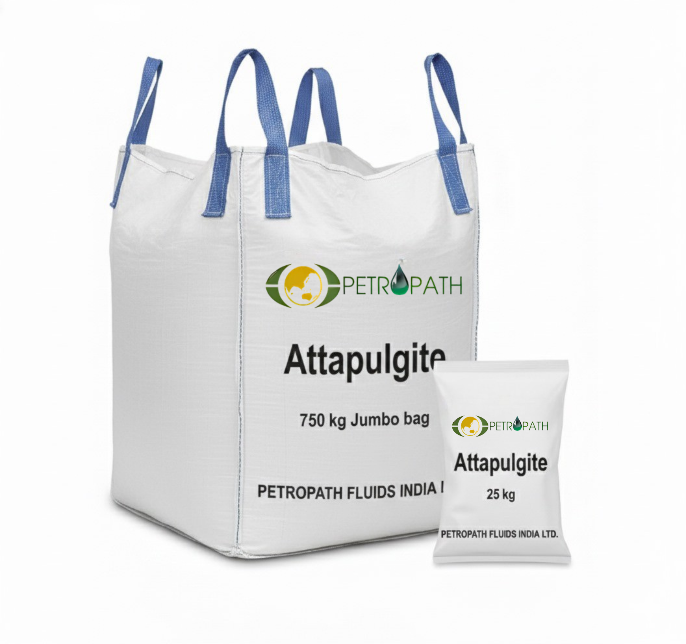
Petropath lists 25 kg paper bags with an inner HDPE liner and 750 kg jumbo bags, with custom packaging available. The page also lists an HS code of 2508.40.00 and CAS number 12174-11-7. Confirm packaging, lead time, shipping arrangements, and documentation with the supplier before ordering, particularly for offshore projects with tight logistics schedules.
Why Consider Petropath?
Petropath Fluids India Limited supplies drilling-fluid materials for offshore and other demanding applications. When evaluating Attapulgite Sea Water Bentonite, customers should confirm product specifications, batch quality documents, packaging, technical support, and suitability for their planned water source and mud system. A clear technical review helps align material selection with the project’s performance and handling requirements.
Conclusion
Attapulgite Sea Water Bentonite is a practical clay option for drilling-fluid systems that need viscosity development in seawater or other saline environments. Its particle structure can support suspension, cuttings transport, and fluid preparation in offshore, deepwater, and high-salinity applications. Select the grade using current technical documentation, test it with the planned formulation, and monitor mud properties during use.
Contact our team today to request a quote, get technical guidance, or explore customization options for your HTHP testing needs.
We provide worldwide delivery, custom configurations, and technical support tailored to your operational needs.