

Powerful Corrosion Inhibitor for Oil & Gas Lines: 6 Ways to Protect Pipeline Integrity
Pipelines are essential to oil and gas production, processing, and transportation. They carry crude oil, natural gas, produced water, and multiphase fluids through operating environments that can expose metal surfaces to corrosive substances. Carbon dioxide (CO₂), hydrogen sulfide (H₂S), dissolved oxygen, salts, organic acids, and water can all contribute to internal corrosion. If corrosion is not controlled, gradual metal loss can weaken pipelines, increase maintenance requirements, interrupt production, and create leak and safety risks.
A dependable Corrosion Inhibitor for Oil & Gas Lines is an important part of a planned pipeline integrity programme. A Corrosion Inhibitor for Oil & Gas Lines also supports a proactive approach to managing internal corrosion. For operators managing complex production networks, a Corrosion Inhibitor for Oil & Gas Lines can form one element of a preventive asset-protection strategy. It helps reduce corrosion by forming a protective film on internal metal surfaces, limiting direct contact between the steel and corrosive fluids. Selecting the right treatment and monitoring its performance can help operators protect critical assets and maintain reliable operations.
What Is a Corrosion Inhibitor for Oil & Gas Lines?
A Corrosion Inhibitor for Oil & Gas Lines is a chemical treatment designed to slow the corrosion of metal equipment and pipeline systems exposed to oilfield fluids. In production and transportation environments, the treatment is introduced into the system so that active molecules can interact with the internal metal surface and create a protective layer.
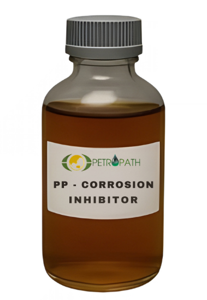
PP-COR-OG is formulated with fatty amines and surfactant blends to support corrosion protection in oil and gas lines exposed to challenging operating conditions, including environments where CO₂ and H₂S may be present. The formulation is intended to provide film-forming protection for pipeline systems. The appropriate treatment programme should always be selected according to the fluid composition, operating conditions, metallurgy, and field testing results. Selecting a Corrosion Inhibitor for Oil & Gas Lines therefore requires an understanding of the actual service environment, not simply the name of the chemical.
Why Corrosion Control Matters in Oil and Gas Pipelines
A reliable Corrosion Inhibitor for Oil & Gas Lines helps operators manage internal corrosion before it develops into a major integrity issue.
Internal corrosion can develop over time and may not be visible during routine external inspections. Its severity depends on factors such as water content, gas composition, temperature, pressure, flow conditions, and the presence of deposits or microorganisms. A suitable Corrosion Inhibitor for Oil & Gas Lines helps address this risk as part of a wider integrity management strategy.
Common corrosion contributors include:
Carbon dioxide (CO₂): When CO₂ dissolves in water, it can form carbonic acid and contribute to steel corrosion.
Hydrogen sulfide (H₂S): Sour service conditions can cause corrosion and may introduce additional material-integrity concerns.
Produced water: Water containing dissolved salts and other contaminants can create an environment that supports electrochemical corrosion.
Dissolved oxygen: Oxygen ingress can accelerate corrosion, particularly in water-handling systems.
Microbial activity and deposits: Certain microorganisms and under-deposit conditions can contribute to localized corrosion.
Without effective control, corrosion may lead to wall-thickness reduction, leaks, unplanned shutdowns, repair costs, and environmental consequences. Chemical treatment is therefore most effective when combined with inspection, monitoring, and sound operating practices.
How Film-Forming Corrosion Inhibitors Work
The performance of a Corrosion Inhibitor for Oil & Gas Lines depends on effective contact between the treatment and the metal surfaces that need protection.
Many oilfield corrosion inhibitors protect steel through adsorption and film formation. After the chemical is introduced and distributed through the system, active components can attach to the metal surface. They form a thin barrier that reduces the contact between the steel and corrosive water or other aggressive species.
A Corrosion Inhibitor for Oil & Gas Lines can support protection through four connected stages. Understanding these stages helps explain how a Corrosion Inhibitor for Oil & Gas Lines contributes to an overall corrosion management plan:
1. Surface adsorption
Active inhibitor molecules are attracted to and attach to the internal metal surface. Effective distribution is important so that the treatment can reach the areas requiring protection.
2. Protective film formation
The adsorbed molecules form a thin film over the metal. The continuity and stability of this film depend on the formulation and the conditions inside the pipeline.
3. Reduced contact with corrosive fluids
The protective layer helps limit direct interaction between the steel and corrosive components in the produced fluid. This can reduce the conditions that drive corrosion reactions.
4. Corrosion-rate control
By limiting the metal’s exposure to corrosive fluids, the treatment helps reduce corrosion rates when correctly selected, applied, and monitored. Actual performance should be confirmed under representative field conditions.
Key Benefits of Using a Pipeline Corrosion Inhibitor
When correctly selected, a Corrosion Inhibitor for Oil & Gas Lines can support safer, more dependable pipeline operation.
A well-managed Corrosion Inhibitor for Oil & Gas Lines programme can contribute to several operational benefits. The value of a Corrosion Inhibitor for Oil & Gas Lines is greatest when treatment is matched to the system and verified through monitoring:
Better pipeline integrity
Reducing internal corrosion helps preserve pipeline wall thickness and supports the integrity of flow lines, gathering networks, and transportation systems.
Lower maintenance requirements
Corrosion-related repairs, inspections, and shutdowns can place pressure on operating budgets. Effective chemical treatment, combined with monitoring, can help reduce avoidable maintenance and repair requirements.
More reliable production and transportation
Pipeline failures can interrupt the movement of crude oil, natural gas, and produced fluids. A consistent corrosion control programme supports dependable operations and helps reduce the likelihood of corrosion-related disruptions.
Longer service life for assets
Pipelines and associated equipment represent significant capital investments. Managing corrosion helps protect these assets and can support longer, more productive service.
Improved operational safety
Leaks caused by corrosion can expose workers, communities, and the environment to serious risks. A suitable Corrosion Inhibitor for Oil & Gas Lines, used as part of a broader safety and integrity programme, helps reduce one important source of pipeline failure.
Where Are Oil and Gas Corrosion Inhibitors Used?
A Corrosion Inhibitor for Oil & Gas Lines may be considered for a range of production and transportation assets, subject to application-specific evaluation.
Corrosion inhibitor treatments are used across several parts of the oil and gas value chain, depending on the system design and chemical compatibility.
Production flow lines: Help manage internal corrosion in lines carrying produced fluids from wells.
Gathering and transmission pipelines: Support corrosion control in networks transporting crude oil, natural gas, or multiphase streams.
Wellhead and production equipment: May be included in treatment programmes for associated piping and equipment where compatible.
Offshore and onshore facilities: Support corrosion management in production systems operating under different environmental and process conditions.
Water-handling systems: Can be considered for produced-water and related lines after checking compatibility and treatment requirements.
Processing facilities: May be used in suitable process piping and associated equipment as part of a site-specific corrosion programme.
The right Corrosion Inhibitor for Oil & Gas Lines depends on the intended application. Before choosing a Corrosion Inhibitor for Oil & Gas Lines, operators should identify the line’s service conditions and the type of corrosion being managed. A treatment suitable for one pipeline may not automatically be suitable for another, particularly where water cut, flow regime, metallurgy, or fluid chemistry differs.
Factors to Consider When Selecting an Inhibitor
The selection of a Corrosion Inhibitor for Oil & Gas Lines should be based on measurable operating conditions and technical requirements.
Choosing a chemical based only on a general product description is not enough. A Corrosion Inhibitor for Oil & Gas Lines must be evaluated against the actual process conditions and operating objectives. Operators should consider the following factors before implementing a treatment programme.
Fluid composition
Measure or assess water cut, salinity, CO₂, H₂S, oxygen, and other relevant contaminants. These factors influence corrosion risk and the type of protection required.
Operating temperature and pressure
Temperature and pressure can affect chemical behaviour, film stability, and distribution. The inhibitor should be evaluated against the pipeline’s real operating envelope.
Flow rate and pipeline design
Flow velocity, turbulence, residence time, and pipeline geometry can influence how evenly the chemical reaches internal surfaces and how well a protective film is maintained.
Compatibility with other chemicals
Production systems may use scale inhibitors, demulsifiers, biocides, and other treatment chemicals. Compatibility testing helps identify possible interactions before full-scale application.
Monitoring and field testing
Corrosion coupons, probes, fluid analysis, inspection data, and controlled field trials can help evaluate treatment performance. Dosage should be established by qualified technical personnel based on test results and operating conditions, rather than applying a universal rate.
Best Practices for an Effective Corrosion Management Programme
Consistent monitoring is essential to confirm that a Corrosion Inhibitor for Oil & Gas Lines continues to perform as intended as operating conditions change.
A Corrosion Inhibitor for Oil & Gas Lines works best when it is part of a structured programme rather than a stand-alone response to visible damage. A properly managed Corrosion Inhibitor for Oil & Gas Lines treatment should be supported by baseline data, routine monitoring, and documented operating procedures.
Establish a baseline corrosion assessment, identify high-risk locations, and define measurable performance targets. Confirm chemical compatibility and distribution, then apply the treatment using an appropriate injection or batch-treatment method specified for the system.
Operators should review monitoring data at planned intervals and adjust the programme when production conditions change. Changes in water cut, gas composition, temperature, flow rate, or operating strategy can alter corrosion risk. Keep records of chemical use, inspection findings, corrosion rates, and corrective actions so that decisions are based on operating evidence.
Personnel should follow the product’s safety data sheet, site procedures, and applicable handling requirements. Storage, transfer, dosing, and spill-response arrangements should be managed by trained staff using suitable personal protective equipment.
Supporting Pipeline Protection with PP-COR-OG
A Corrosion Inhibitor for Oil & Gas Lines should be selected with both current corrosion risks and long-term asset integrity objectives in mind.
PP-COR-OG is a corrosion inhibitor formulated with fatty amines and surfactant blends for oil and gas line applications. Its film-forming approach is intended to help protect metal surfaces in systems exposed to corrosive production fluids, including conditions involving CO₂ and H₂S. As with any oilfield chemical, suitability should be confirmed against the specific pipeline conditions and through appropriate laboratory or field evaluation.
For operators assessing a Corrosion Inhibitor for Oil & Gas Lines, product selection should consider the target system, fluid chemistry, operating range, compatibility with other treatments, and the monitoring method that will be used to verify results. A technically supported treatment plan helps ensure that chemical use is aligned with actual corrosion-control needs.
Conclusion
Corrosion can threaten pipeline integrity, operational continuity, and safety throughout oil and gas production and transportation. CO₂, H₂S, produced water, oxygen, salts, and operating conditions can all contribute to internal metal degradation. A suitable Corrosion Inhibitor for Oil & Gas Lines helps reduce corrosion by forming a protective film on internal metal surfaces and limiting their exposure to aggressive fluids.
The strongest results come from matching the inhibitor to the pipeline environment, confirming compatibility, applying the treatment correctly, and monitoring performance over time. With a structured corrosion management programme and an appropriate solution such as PP-COR-OG, operators can support asset integrity, reduce avoidable maintenance, and improve the reliability of oil and gas operations.
For bulk supply, technical data sheets, or corrosion control consultation for your pipeline systems, contact Petropath Fluids India Ltd.
Petropath oilfield chemicals – your trusted partner for oilfield corrosion prevention solutions.