

Dead Weight Filter Press: 7 Powerful Benefits for Accurate Fluid Loss Testing
Introduction
Maintaining drilling fluid quality is essential for safe, efficient, and cost-effective drilling operations. One of the most important parameters engineers must monitor is filtration control. Excessive fluid loss can cause formation damage, increase mud consumption, affect wellbore integrity, and create operational difficulties. This makes accurate laboratory testing an important part of drilling fluid management.
A Dead Weight Filter Press is a valuable laboratory instrument used to evaluate the filtration characteristics of drilling fluids under controlled pressure conditions. It helps drilling engineers measure filtrate volume and examine filter cake formation, providing essential information for optimizing mud formulations. At Petropath Fluids India Ltd., we recognize the importance of dependable testing equipment in supporting consistent drilling performance and laboratory accuracy.
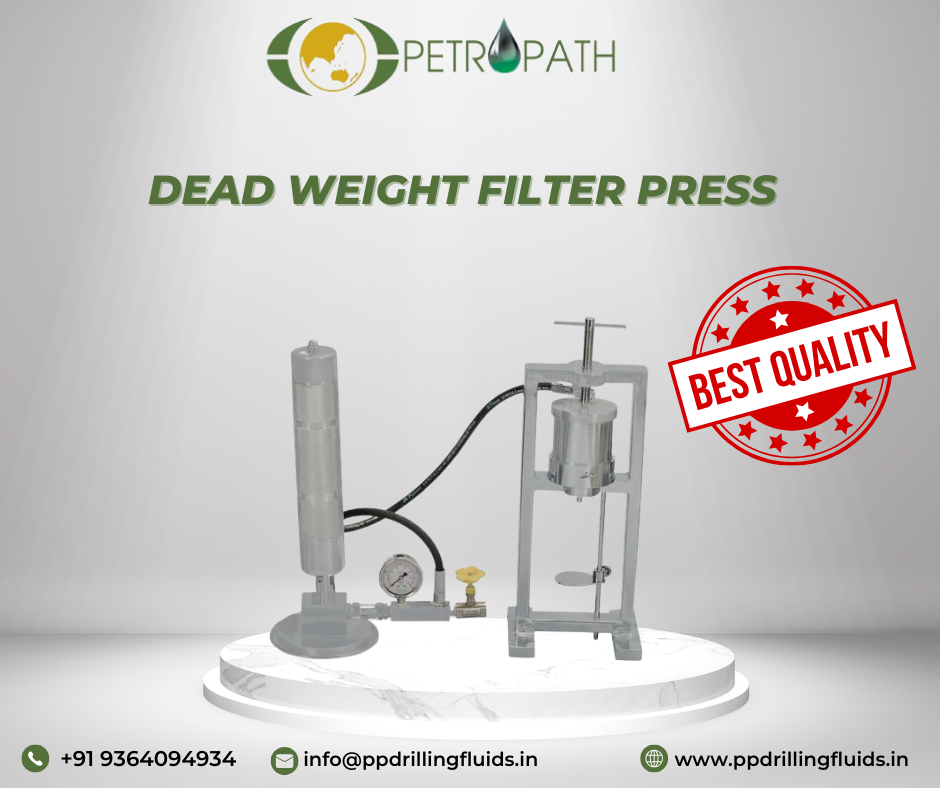
What Is a Dead Weight Filter Press?
A Dead Weight Filter Press is a specialized laboratory instrument designed to measure the fluid loss characteristics of drilling mud. It applies a controlled pressure to a mud sample placed inside a filtration cell, allowing the liquid portion to pass through a filter medium while solid particles form a filter cake.
The collected filtrate is measured over a specified testing period, while the thickness and condition of the filter cake are examined to evaluate filtration performance.
Unlike pressure systems that depend on external gas cartridges and regulators, a dead-weight mechanism uses calibrated weights to apply the required pressure. Depending on the instrument configuration, it can support different testing pressures, making it useful for controlled drilling fluid analysis.
7 Powerful Benefits of Using a Dead Weight Filter Press
1. Accurate Fluid Loss Measurement
Accurate filtration measurements help engineers understand how drilling fluids behave under pressure. A Dead Weight Filter Press provides controlled testing conditions, allowing laboratories to measure filtrate volume and evaluate fluid loss characteristics consistently.
2. Better Filter Cake Evaluation
Filter cake quality plays an important role in maintaining wellbore integrity. The instrument helps technicians examine cake thickness, texture, and uniformity. A thin, relatively impermeable filter cake is generally desirable because it helps minimize excessive filtrate invasion into formations.
3. Improved Drilling Fluid Formulation
Reliable test results help engineers select suitable filtration-control additives, including PAC, CMC, and starch. By evaluating different formulations, laboratories can identify appropriate additive concentrations and improve drilling mud performance.
4. Enhanced Wellbore Stability
Excessive fluid invasion can negatively affect sensitive formations and contribute to wellbore instability. Regular Fluid Loss Testing helps identify filtration-control problems before they become significant operational concerns.
5. Consistent Laboratory Testing
Calibrated dead weights provide a controlled pressure application method. This supports repeatable testing when the instrument is correctly operated, maintained, and used according to the applicable testing procedure.
6. Simple Operation and Maintenance
The straightforward mechanical design makes the equipment convenient for laboratory technicians. Depending on the model, the system can reduce dependence on external pressure accessories and simplify routine testing activities.
7. Useful for Field and Laboratory Applications
A compact instrument configuration can make filtration testing practical in drilling laboratories, research facilities, and suitable field-testing environments. This allows engineers to evaluate mud performance at different stages of drilling operations.
How Does a Dead Weight Filter Press Work?
The operating principle is based on applying controlled pressure to a drilling fluid sample and measuring the liquid that passes through a filter medium.
The typical testing procedure involves the following steps:
Sample Preparation: Collect and prepare a representative drilling fluid sample for testing.
Cell Preparation: Place the appropriate filter paper or filter medium inside the filtration cell.
Sample Loading: Transfer the drilling mud into the mud cell according to the instrument instructions.
Equipment Assembly: Secure the cell, seals, and supporting components correctly.
Pressure Application: Apply the specified pressure using the calibrated dead weights.
Filtrate Collection: Collect the liquid passing through the filter medium during the prescribed test period, commonly 30 minutes for standard testing.
Result Evaluation: Measure filtrate volume and examine the resulting filter cake.
Following the correct procedure ensures more meaningful results for Drilling Fluid Analysis and helps engineers compare different mud formulations.
Key Components of the Equipment
A typical Dead Weight Filter Press consists of several important components:
Mud Cell: Holds the drilling fluid sample during testing.
Filter Paper: Provides the filtration medium through which filtrate passes.
Dead Weights: Apply the specified testing pressure.
Filtrate Collection Tube: Collects and measures the liquid released during filtration.
Support Stand and Clamp: Secure the assembly during operation.
Pressure Mechanism: Transfers the applied load to the sample as designed.
Each component contributes to reliable filtration testing and supports the overall performance of laboratory mud testing equipment.
Why Is Fluid Loss Testing Important in Drilling Operations?
Filtration control is essential for maintaining drilling fluid performance across different geological formations. Poor filtration characteristics can contribute to formation damage, excessive filter cake development, differential sticking risks, and increased operational expenses.
Regular Fluid Loss Testing helps operators:
Minimize unwanted filtrate invasion into formations.
Evaluate filtration-control additives.
Maintain suitable filter cake characteristics.
Support wellbore stability and formation integrity.
Reduce potential drilling complications and non-productive time.
These measurements help engineers make informed decisions about drilling fluid properties and treatment requirements.
Applications Across the Oil and Gas Industry
A Dead Weight Filter Press is useful in several professional environments where drilling fluid filtration characteristics need to be evaluated.
Common applications include:
Oil and gas drilling fluid laboratories.
Drilling mud formulation and quality-control facilities.
Research and development laboratories.
Educational institutions and technical training centres.
Oilfield service companies.
Drilling fluid additive evaluation and performance testing.
Its practical testing capabilities make it an important instrument for laboratories involved in routine mud evaluation.
Why Choose Petropath Fluids India Ltd.?
Petropath Fluids India Ltd. focuses on providing dependable solutions for the oil and gas industry, including drilling fluid chemicals, laboratory equipment, and technical support. We understand that reliable testing instruments are essential for evaluating mud properties and maintaining operational standards.
Our commitment to quality, technical expertise, and customer support helps laboratories and drilling professionals select suitable equipment for their testing requirements. Whether you need equipment for routine filtration measurements or broader drilling fluid evaluation, our team can assist you in identifying an appropriate solution.
Conclusion
Accurate filtration measurement is an important part of effective drilling fluid management. A Dead Weight Filter Press helps engineers evaluate filtrate volume, examine filter cake characteristics, and improve drilling mud formulations through controlled laboratory testing.
From supporting filtration-control additive selection to contributing to better wellbore stability, this instrument plays a valuable role in drilling fluid evaluation. Choosing suitable testing equipment from an experienced industry supplier such as Petropath Fluids India Ltd. can help laboratories maintain dependable testing practices and support efficient drilling operations.