

Decanter Centrifuge: 9 Powerful Ways It Improves Drilling Solids Control
Introduction
Efficient solids control is essential for safer, cleaner, and more cost-effective drilling operations. During drilling, unwanted fine solids can accumulate in the mud system, affecting fluid properties, increasing chemical consumption, reducing drilling efficiency, and creating more waste. A high-performance Decanter Centrifuge helps operators control these ultra-fine solids before they become a costly operational issue.
At Petropath Fluids India Ltd., our Decanter Centrifuge is engineered for demanding oilfield environments where reliable drilling mud separation is critical. It removes low-gravity solids from water-based mud, oil-based mud, and synthetic mud systems while supporting mud reuse, barite recovery, and reduced disposal requirements.
From conventional wells to high-pressure, high-temperature drilling environments, a dependable Decanter Centrifuge helps maintain cleaner drilling fluids and stronger overall solids control performance.
What Is a Decanter Centrifuge?
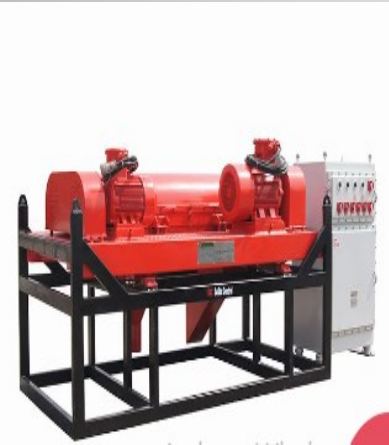
A Decanter Centrifuge is advanced solids control equipment used to separate very fine drilled solids from drilling fluid. It works by generating high centrifugal force inside a rotating bowl. The bowl spins at high speed, forcing heavier solids toward the outer wall while the cleaned liquid phase moves separately through the system.
A scroll conveyor inside the bowl continuously transports the separated solids toward the discharge end. This continuous process enables the Decanter Centrifuge to handle drilling fluid efficiently without frequent interruptions.
Unlike primary solids control equipment such as shale shakers and desanders, centrifuges are designed for finer particle separation. They are particularly useful for removing ultra-fine low-gravity solids that can damage mud quality and affect drilling performance.
How a Decanter Centrifuge Supports Drilling Operations
A Decanter Centrifuge plays an important role in maintaining the desired density, rheology, and cleanliness of drilling mud. Fine solids can increase plastic viscosity, raise dilution needs, reduce penetration rates, and increase wear on pumps and other equipment.
By supporting efficient drilling mud separation, the centrifuge helps drilling teams maintain better fluid performance. It can also recover valuable weighting materials such as barite, allowing operators to reuse costly drilling additives instead of losing them with discarded solids.
This makes the system useful for both performance improvement and cost control in oil and gas drilling.
9 Key Benefits of a Decanter Centrifuge
1. Removes Ultra-Fine Solids
A Decanter Centrifuge can separate fine and ultra-fine solids that are difficult to remove using conventional equipment. This helps prevent unwanted solids buildup in the active mud system.
2. Improves Drilling Mud Quality
Cleaner drilling fluids support better rheology, density control, filtration behaviour, and hydraulic performance. This can contribute to more stable and efficient drilling operations.
3. Reduces Fluid Dilution Costs
When solids levels rise, operators often add water, base oil, chemicals, or new mud to restore desired properties. A Decanter Centrifuge reduces the need for excessive dilution by removing unwanted fine solids at the source.
4. Supports Barite Recovery
Barite is a valuable weighting material used to maintain drilling mud density. With the right operating settings, a barite recovery system can help retain reusable barite while separating unwanted low-gravity solids.
5. Minimises Drilling Waste
Effective drilling waste management begins with reducing the quantity of material requiring disposal. By separating solids efficiently, the centrifuge lowers waste volume and can reduce transportation, treatment, and disposal costs.
6. Works with Multiple Mud Systems
Petropath’s Decanter Centrifuge can be configured for oil-based mud, water-based mud, and synthetic-based mud systems. This makes it suitable for a wide range of drilling conditions and project requirements.
7. Delivers High G-Force Separation
High rotational speed produces strong centrifugal force for precise separation. Petropath centrifuges can generate up to 3000 G-force, helping remove fine solids and improve drilling mud separation performance.
8. Supports Compact Rig-Site Installation
The skid-mounted design allows the Decanter Centrifuge to be transported, positioned, and integrated into existing solids control systems more easily. Its compact footprint is beneficial where rig space is limited.
9. Helps Lower Environmental Impact
Reducing mud waste, recovering reusable fluid, and lowering chemical consumption support more responsible drilling practices. A Decanter Centrifuge helps operators work toward cleaner and more sustainable oilfield operations.
Key Features of Petropath’s Decanter Centrifuge
Petropath Fluids India Ltd. provides reliable solids control equipment designed for field use and long-term performance. Key features include:
- High G-force separation for accurate fine-solids removal
- Dual-mode manual and automated control options
- Compact, skid-mounted, rig-ready construction
- Tungsten-carbide-coated scroll flights for wear resistance
- Dual-motor drive system with main and back drive
- Compatibility with OBM, WBM, and SBM drilling fluids
- Lifting-certified and forklift-ready skid options
- Custom configurations for different mud-processing requirements
Technical Specifications
| Parameter | Specification |
|---|---|
| Bowl Diameter | 450 mm–600 mm |
| Bowl Length | Up to 1600 mm |
| Maximum Rotational Speed | Up to 3400 RPM |
| G-Force | Up to 3000 G |
| Processing Capacity | 30–60 m³/h |
| Drive System | Dual motor: main and back drive |
| Scroll Material | Stainless steel with carbide coating |
| Control Panel | ATEX / IECEx certified on request |
| Skid Type | Lifting certified and forklift ready |
Applications in Oil and Gas Drilling
A Decanter Centrifuge is widely used in drilling operations where fluid quality, waste reduction, and barite recovery are priorities. Common applications include:
- Solids control for OBM and WBM systems
- Fine solids removal from active drilling mud
- Barite recovery and mud weight management
- Dewatering of drill cuttings
- Reduction of drilling fluid dilution
- Support for drilling waste management programs
- Improved mud recycling and reuse
Why Choose Petropath Fluids India Ltd.?
Petropath’s Decanter Centrifuge is backed by practical oilfield expertise, durable engineering, and responsive technical support. Our systems are designed to perform in challenging drilling environments while helping operators manage fluid quality and operating costs.
With experience across regions such as the Cambay Basin, KG Basin, and Assam-Arakan Fold Belt, Petropath understands the real-world requirements of drilling operations. Our team supports equipment selection, commissioning, maintenance, training, spare availability, and service requirements.
Conclusion
A Decanter Centrifuge is a vital investment for drilling teams seeking cleaner mud, lower waste volume, improved barite recovery, and stronger solids control. By removing ultra-fine solids efficiently, it helps maintain drilling fluid performance while reducing operational and environmental costs.
For dependable drilling mud separation and advanced solids control equipment, Petropath Fluids India Ltd. offers robust centrifuge solutions built for reliable field performance.