

PP – Calcium Carbonate: 7 Powerful Benefits for Better Drilling Performance
Introduction
Modern oil and gas drilling operations demand drilling fluids that can control fluid loss, maintain wellbore stability, and protect formations under challenging downhole conditions. Selecting the right mineral additive can significantly influence drilling efficiency, formation protection, and overall operational costs.
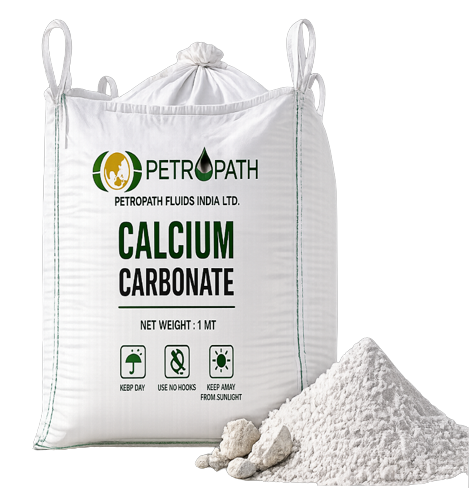
PP – Calcium Carbonate is a high-quality mineral additive manufactured by Petropath Fluids India Ltd. It is designed for demanding oilfield applications where controlled particle size, consistent quality, and effective formation sealing are essential.
Derived from high-quality limestone, this calcium carbonate product is available in fine, medium, and coarse grades. Its particle-size flexibility allows drilling engineers to select the appropriate grade for different formation conditions and fluid systems.
What Is PP – Calcium Carbonate?
PP – Calcium Carbonate is a processed calcium carbonate mineral based on CaCO₃ and engineered for use in drilling fluids and other industrial applications. In oilfield operations, it can act as a calcium carbonate drilling additive, helping bridge formation pores and fractures while supporting fluid loss control.
The material is available in different particle sizes to provide effective packing across various pore structures. This makes it useful as a drilling mud bridging agent in applications where formation sealing and wellbore integrity are important.
Because calcium carbonate is acid-reactive, it can also be considered for applications where controlled removal of the material may be required after the drilling operation.
7 Key Benefits of PP – Calcium Carbonate
1. Effective Fluid Loss Control
Uncontrolled filtration into permeable formations can negatively affect drilling performance and increase the risk of formation damage. PP – Calcium Carbonate helps create an effective sealing layer across permeable zones.
Its controlled particle distribution allows particles to bridge pore openings and reduce fluid invasion, making it a valuable CaCO3 oilfield chemical for fluid-loss-management programs.
2. Excellent Bridging and Sealing Performance
Formation sealing is particularly important when drilling through naturally fractured or highly permeable formations. Properly selected calcium carbonate particles can bridge openings and contribute to a low-permeability filter cake.
As a drilling mud bridging agent, PP – Calcium Carbonate can be selected in fine, medium, or coarse grades depending on the formation characteristics and desired particle-packing distribution.
3. Supports Wellbore Stability
Maintaining wellbore integrity is a major priority in drilling operations. Excessive filtrate invasion and inadequate formation sealing can contribute to instability and operational complications.
PP – Calcium Carbonate supports formation sealing and fluid-loss control, making it a useful wellbore stability additive within appropriately designed drilling-fluid systems.
By reducing unwanted fluid invasion, it can help drilling teams maintain better control over downhole conditions.
4. Compatible With Different Drilling Fluid Systems
Modern drilling operations use different fluid technologies depending on formation characteristics, environmental requirements, and operational objectives.
PP – Calcium Carbonate can be incorporated into water-based mud (WBM), oil-based mud (OBM), and synthetic-based mud (SBM) systems when properly formulated.
This compatibility provides drilling-fluid engineers with greater flexibility when designing fluid-loss and bridging treatments for different wells.
5. Controlled Particle Size for Targeted Applications
One of the most important characteristics of a bridging material is particle-size distribution. A single particle size may not provide optimal packing across different formation openings.
PP – Calcium Carbonate is available in fine, medium, and coarse grades, allowing operators to select the appropriate material based on formation permeability, pore size, and treatment objectives.
Using the right particle-size combination can improve bridging efficiency and contribute to more effective formation sealing.
6. Cost-Effective Mineral Additive
Drilling operations continuously focus on reducing non-productive time (NPT) while maintaining fluid performance. A reliable mineral additive can contribute to operational efficiency by supporting fluid-loss control and formation management.
PP – Calcium Carbonate offers a practical and economical option for large-scale drilling-fluid applications. Its multifunctional performance can help reduce the need for unnecessary corrective treatments when incorporated into a properly engineered mud system.
7. Useful Across Multiple Industrial Applications
Although oilfield applications are a major use of PP – Calcium Carbonate, calcium carbonate is also widely used across other industries.
It can function as a filler or extender in paints and coatings, contribute to specific formulations in plastics and rubber, and serve as a calcium source or soil-conditioning material in agriculture.
This versatility makes calcium carbonate a valuable industrial mineral beyond drilling applications.
How PP – Calcium Carbonate Works in Drilling Fluids
The effectiveness of calcium carbonate in drilling fluids depends largely on particle-size selection and formation characteristics. When appropriately sized particles enter a permeable formation, they can bridge pore throats and openings.
As particles accumulate, they can form a sealing structure that limits further filtrate invasion. The resulting barrier can support fluid-loss control and contribute to formation protection.
For optimal performance, drilling engineers should consider formation permeability, particle-size distribution, mud chemistry, concentration, and compatibility with other additives before determining the treatment program.
Typical Physical Properties
Typical properties of PP – Calcium Carbonate include:
Appearance: White powder
Chemical formula: CaCO₃
Specific gravity: Approximately 2.7
pH of 10% slurry: Approximately 9–10
Water solubility: Insoluble in water
Acid behavior: Reactive with acids
Available grades: Fine, medium, and coarse
Actual product specifications should be confirmed with the manufacturer before field application.
Dosage and Application Considerations
The required dosage of PP – Calcium Carbonate depends on formation permeability, loss severity, drilling-fluid composition, and the desired bridging effect.
Particle-size selection is equally important. Fine particles may be suitable for smaller pore openings, while medium and coarse grades can contribute to bridging larger openings. In some applications, combining particle sizes may provide improved packing.
The material can be added directly to the drilling-fluid system according to the mud program and treatment requirements. Compatibility testing and laboratory evaluation are recommended before large-scale field use.
Safety and Handling
Proper industrial handling practices should always be followed when using calcium carbonate powders. Operators should use suitable personal protective equipment and minimize exposure to airborne dust during handling and transfer.
The product should be stored in a dry, well-ventilated location and protected from moisture and incompatible acidic materials. Safety procedures should follow the applicable site requirements and product safety documentation.
Why Choose PP – Calcium Carbonate From Petropath Fluids India Ltd.?
Choosing a consistent-quality mineral additive is essential for predictable drilling-fluid performance. Petropath Fluids India Ltd. manufactures PP – Calcium Carbonate with controlled particle-size options for demanding oilfield applications.
Key advantages include:
Consistent product quality
Fine, medium, and coarse grades
Effective bridging and sealing characteristics
Support for fluid-loss control
Compatibility with appropriately formulated WBM, OBM, and SBM systems
Cost-effective performance
Easy storage and handling
Applications across oilfield and industrial sectors
Conclusion
PP – Calcium Carbonate is a versatile mineral additive that can support modern drilling operations through effective bridging, formation sealing, fluid-loss control, and wellbore management. Its controlled particle-size options make it adaptable to different formation and drilling-fluid requirements.
For drilling teams seeking a practical CaCO3 oilfield chemical for formation sealing and fluid-loss applications, calcium carbonate can provide an economical and flexible solution when properly selected and formulated.
Manufactured by Petropath Fluids India Ltd., PP – Calcium Carbonate offers consistent quality and multiple grade options for oilfield applications and beyond.
Looking for a reliable Calcium carbonate drilling additive supplier?
Petropath Fluids India Ltd.
Get in touch today for bulk orders, technical support, and customized solutions.