

PP – MICA: Powerful Lost Circulation Solution for High-Performance Drilling
Introduction
In modern oil and gas drilling, maintaining circulation and controlling drilling-fluid losses are essential for safe, efficient, and economical operations. Fractured, porous, and naturally weak formations can allow drilling fluids to escape into the formation, resulting in lost circulation, increased mud consumption, wellbore instability, and costly non-productive time.
PP – MICA is a high-performance lost circulation and sealing additive developed by Petropath Fluids Ltd. for demanding drilling-fluid applications. Its unique platy or lamellar particle structure enables it to bridge fractures, seal formation openings, and reduce fluid seepage. By supporting circulation control and wellbore integrity, PP – MICA helps drilling teams improve operational efficiency while minimizing unnecessary fluid losses.
What Is PP – MICA?
PP – MICA is a specially selected mica-based Lost Circulation Material (LCM) designed for use in drilling-fluid systems. Mica has a naturally flexible, plate-like structure that allows its particles to overlap and form an effective sealing layer across pores, fractures, and other openings in formations.
As a lost circulation material mica, it can be used for both preventive and corrective treatments. Fine, medium, and coarse grades can be selected according to formation characteristics, fracture size, and the severity of fluid loss.
The material is insoluble in water and can be incorporated into suitable drilling-fluid systems to provide mechanical bridging and sealing performance.
How PP – MICA Controls Fluid Loss
The effectiveness of PP – MICA comes primarily from its physical particle structure and mechanical sealing mechanism.
When introduced into the drilling fluid, mica particles distribute through the fluid and travel toward permeable or fractured areas. Their flat, flexible particles naturally orient themselves across openings. As the particles overlap and interlock, they create a layered barrier.
Additional solids from the drilling fluid can accumulate around this barrier, strengthening the seal. This process reduces the pathways through which drilling fluid can enter the formation.
As a result, PP – MICA can help reduce seepage, preserve mud volume, and support more stable circulation during drilling operations.
Key Benefits of PP – MICA
Using PP – MICA as part of an appropriate drilling-fluid treatment program can provide several operational advantages:
1. Effective Lost Circulation Control
One of the primary applications of PP – MICA is controlling drilling-fluid losses in permeable and fractured formations. Its plate-like particles help bridge formation openings and create a physical seal.
2. Improved Sealing Performance
The lamellar structure allows mica particles to overlap and form a flexible barrier. This makes the material useful where effective sealing is required without relying solely on rigid granular particles.
3. Reduced Mud Loss
Uncontrolled fluid loss can increase consumption of drilling fluids and additives. As a drilling mud loss control additive, PP – MICA helps reduce unnecessary losses and supports better management of drilling-fluid volumes.
4. Enhanced Wellbore Stability
Maintaining effective sealing around weak or naturally fractured zones can contribute to improved formation integrity. PP – MICA can therefore support wellbore stability as part of a properly engineered drilling-fluid system.
5. Lower Non-Productive Time
Circulation losses can lead to treatment requirements, delays, and additional operational costs. By helping control seepage and lost circulation, PP – MICA can contribute to reduced non-productive time and smoother drilling operations.
Applications of PP – MICA in Oilfield Drilling
PP – MICA is suitable for a variety of applications where fluid-loss and sealing performance are important.
Lost Circulation Treatment
It can be incorporated into LCM treatment programs for formations experiencing partial or moderate circulation losses. Grade selection can be adjusted according to the size and nature of formation openings.
Seepage Control
Fine and appropriately sized mica particles can help reduce fluid seepage into permeable formations. This makes the material useful for maintaining drilling-fluid volume and circulation efficiency.
Preventive LCM Treatment
In formations known to have a high risk of losses, PP – MICA can be considered as part of a preventive treatment strategy. Early intervention may help minimize the severity of circulation problems.
Wellbore Strengthening
The sealing action of mica particles can support wellbore integrity by helping bridge and seal formation features that contribute to fluid invasion.
Drilling Fluid Conditioning
Beyond loss-control applications, mica can complement other drilling-fluid additives where solids suspension and overall fluid-system performance are important.
Compatibility With Drilling Fluid Systems
A major advantage of PP – MICA is its versatility across commonly used drilling-fluid systems. Depending on the formulation and application requirements, it can be incorporated into:
Water-Based Mud (WBM)
Oil-Based Mud (OBM)
Synthetic-Based Mud (SBM)
Polymer-based drilling fluids
Clay-based drilling-fluid systems
It can also be used alongside other LCM materials, including fibers, granular materials, and other bridging additives. The final treatment design should be based on formation characteristics, mud properties, loss severity, and field conditions.
Typical Product Specifications
| Parameter | Typical Specification |
|---|---|
| Product Name | PP – MICA |
| Product Type | Lost Circulation Material (LCM) |
| Appearance | Shiny, flaky mineral powder |
| Structure | Platy / Lamellar |
| Solubility | Insoluble in water |
| Specific Gravity | 2.6–2.9 |
| Particle Size | Fine, Medium, Coarse |
| Primary Application | Loss circulation and seepage control |
Specifications may vary according to the selected grade and application requirements.
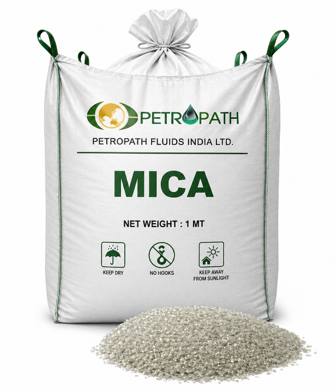
Why Choose PP – MICA by Petropath?
Choosing the right LCM is important for maintaining drilling efficiency and controlling operational costs. PP – MICA offers multiple grade options, allowing drilling professionals to select a suitable particle size for different formation conditions.
Manufactured by Petropath Fluids Ltd., the product is designed for oilfield drilling applications where consistent particle distribution, reliable sealing, and practical handling are essential. Its versatility makes PP – MICA a valuable component of drilling-fluid programs focused on circulation control and wellbore integrity.
Conclusion
Lost circulation can significantly affect drilling performance, fluid consumption, operational continuity, and overall project economics. A properly selected LCM can help address these challenges by creating an effective barrier across formation openings.
PP – MICA provides a practical mica-based approach to fluid-loss and seepage control through its unique platy structure and mechanical bridging mechanism. With fine, medium, and coarse grades, compatibility with multiple drilling-fluid systems, and applications ranging from preventive treatment to lost-circulation control, it can support more efficient drilling operations.
For oilfield teams seeking a reliable mica LCM oilfield solution, PP – MICA offers a versatile option for improving circulation control, reducing mud losses, and supporting stable drilling performance.