

Thermo Cup: Powerful Benefits for Accurate Mud Testing
Thermo Cup is an important instrument for maintaining controlled sample temperature during drilling fluid testing. In the oil and gas industry, temperature conditioning plays a significant role in obtaining consistent and reliable test results. When drilling mud samples are tested under inconsistent temperature conditions, the results may not accurately represent the fluid’s properties under the conditions being evaluated.
Petropath Fluids India Limited offers the Thermo Cup as a specialized instrument for controlled heating of drilling mud samples. Designed for laboratory and rig-site applications, it supports temperature conditioning before testing and helps testing personnel maintain more consistent sample conditions.
For professionals working with drilling fluid analysis, choosing suitable mud laboratory equipment is an important part of maintaining testing efficiency and repeatability.
Why Temperature Control Matters in Drilling Fluid Testing
Drilling fluids are evaluated through different testing procedures to understand their properties and performance. Temperature is an important consideration during these procedures because inconsistent sample conditions can affect the interpretation and repeatability of test results.
The Thermo Cup helps address this requirement by providing controlled heating for drilling mud samples. It supports sample preparation before viscosity measurements, rheological evaluations, and other relevant laboratory procedures.
Consistent temperature conditioning helps testing personnel establish suitable sample conditions before measurements begin. This makes temperature management a valuable consideration for laboratories and field teams working with drilling fluids.
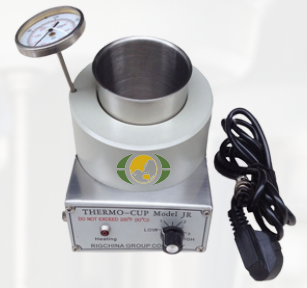
Key Features of the Thermo Cup
1. Heavy-Duty Stainless-Steel Construction
The Thermo Cup features stainless-steel construction intended to support durability in demanding oilfield environments. Equipment used in drilling fluid laboratories and field operations must be suitable for regular handling and testing activities.
Its robust construction makes it a practical option for professionals who require dependable equipment for routine mud testing applications.
2. Heating System for Sample Conditioning
Controlled heating is a central function of the Thermo Cup. It is designed to heat drilling mud samples for temperature conditioning before testing.
Proper sample preparation helps establish more consistent testing conditions. Rather than depending entirely on separate heating arrangements, testing personnel can use a dedicated instrument for this purpose.
3. Adjustable Temperature Control
Temperature requirements can differ according to the testing procedure. The adjustable control provided on the Thermo Cup allows users to set the required temperature within the instrument’s operating range.
This feature supports practical temperature management during drilling fluid testing. Users should follow the manufacturer’s operating instructions and confirm the required temperature for each test before beginning the procedure.
4. Insulated Body Design
Thermal insulation helps reduce heat loss during sample conditioning. The insulated design of the Thermo Cup supports temperature management while the sample is being prepared for testing.
Users should still monitor the sample and follow the instrument’s instructions to maintain appropriate conditions throughout the testing process.
5. Compact and Portable Design
Laboratory and rig-site teams often need equipment that can be handled conveniently in different working environments. The compact design of the Thermo Cup makes it suitable for consideration in both laboratory setups and field testing operations.
Its practical design supports sample conditioning where drilling fluid testing activities are carried out.
Benefits of Using a Thermo Cup for Mud Testing
Improved Testing Consistency
Maintaining suitable sample temperature before testing helps reduce variations associated with inconsistent conditioning. The Thermo Cup supports a more controlled preparation process, helping personnel work toward repeatable testing conditions.
Support for Viscosity and Rheology Testing
Viscosity and rheological evaluations are important parts of drilling fluid analysis. Temperature conditioning is a relevant consideration when preparing samples for these procedures.
The Thermo Cup can be used to condition samples before measurements with suitable mud testing instruments, including a Fann Viscometer, in accordance with the applicable testing procedure.
More Efficient Laboratory Workflows
A dedicated sample-heating instrument can simplify temperature conditioning within a mud laboratory. By providing a specific setup for heating samples, the Thermo Cup supports organized testing workflows and reduces reliance on separate heating arrangements.
Versatility for Drilling Fluid Samples
Drilling operations use different types of fluids, including water-based and oil-based muds. The Thermo Cup is presented for use with different drilling mud samples. Compatibility and operating requirements should be confirmed against the manufacturer’s instructions before use with a particular fluid.
Practical Use in Field and Laboratory Environments
The instrument’s compact construction supports its use in mud laboratories, quality control facilities, and rig-site testing environments. This makes it relevant to teams that require temperature conditioning as part of their regular drilling fluid evaluation process.
Applications of the Thermo Cup
The Thermo Cup supports several drilling fluid testing environments.
Mud laboratories: Laboratory personnel can use it to condition drilling mud samples before relevant viscosity, rheology, filtration, and density testing procedures, where appropriate to the method.
Quality control units: Quality control teams can incorporate temperature conditioning into sample preparation and product evaluation workflows.
Rig-site operations: Field personnel can use the instrument for drilling mud sample conditioning as part of on-site testing activities.
Petroleum engineering institutions: Educational laboratories can use suitable mud testing equipment to demonstrate how sample preparation and temperature conditions relate to drilling fluid evaluation.
Why Choose Petropath Fluids India Limited?
Petropath Fluids India Limited provides equipment for drilling fluid testing and mud laboratory applications. Selecting equipment designed for its intended testing purpose can help laboratories organize sample preparation and routine evaluation procedures.
The company’s mud testing equipment range includes instruments such as the Thermo Cup, viscometers, and retort kits. This range supports professionals seeking equipment for different aspects of drilling fluid analysis.
When selecting a Thermo Cup, users should consider their testing requirements, the manufacturer’s specifications, the required operating temperature, and compatibility with the intended sample. Following the supplied operating and maintenance instructions is also important for dependable equipment use.
FAQs
A Thermo Cup is used to heat and condition drilling mud samples before testing. It helps maintain suitable sample temperature for relevant drilling fluid evaluation procedures in laboratory and rig-site environments.
The Thermo Cup is intended for drilling mud sample conditioning. However, compatibility with specific water-based, oil-based, or synthetic drilling fluids should be confirmed with Petropath Fluids India Limited before use.
The heating time depends on the initial sample temperature, the required temperature, the sample properties, and the instrument’s heating capacity. Contact Petropath Fluids India Limited for the verified heating time for a 350 mL sample.
Yes, it can support sample preparation before compatible mud testing procedures, including viscosity and rheology measurements using suitable instruments. Always follow the applicable testing method and equipment instructions.
Routine cleaning and maintenance should follow the manufacturer’s instructions. Allow the instrument to cool safely before cleaning, and use cleaning methods compatible with its materials and the drilling fluid being tested.